

Every day, you scroll, search, click, and share online—but have you ever stopped to wonder who actually owns your data?
Here’s a surprising reality: most of the internet today quietly collects and controls your personal information. From the videos you watch to the posts you like, everything is tracked, stored, and often monetized by large tech companies—while you remain just a user, not the owner.
Think about social media for a moment. You create content, build an audience, and invest your time—yet the platform controls your reach, your visibility, and even your earnings. In simple terms, you contribute the value, but you don’t truly own it.
But what if the internet worked differently? What if you had full control over your data, identity, and digital assets—without relying on middlemen?
This is where Web 3.0 begins.
Web 3.0 represents a new evolution of the internet—one that is decentralized, transparent, and designed to give power back to users. In this guide, you’ll discover what Web 3.0 really means, how it works, and why it’s shaping the future of the digital world.
Web 3.0 Meaning and Definition
Web 3.0 is the next generation of the internet where users are not just visitors, but owners of their data and digital assets. Instead of being controlled by big companies, information is stored and managed through decentralized technologies like blockchain, making it more secure and transparent. In simple terms, Web 3.0 gives control back to the users.
For example, on today’s social media platforms like as ( Meta , TikTok , Amazon ) , companies control your content, but in Web 3.0, you have full ownership and control.
Key characteristics of Web 3.0 include:
- Decentralization – No single entity controls the internet.
- Blockchain Technology – Ensures transparency, trust, and security.
- Semantic Web – Smarter search engines that understand human intent.
- Artificial Intelligence – Personalized and intelligent recommendations.
- Token Economy – Digital assets (cryptocurrencies, NFTs) enabling peer-to-peer value exchange.
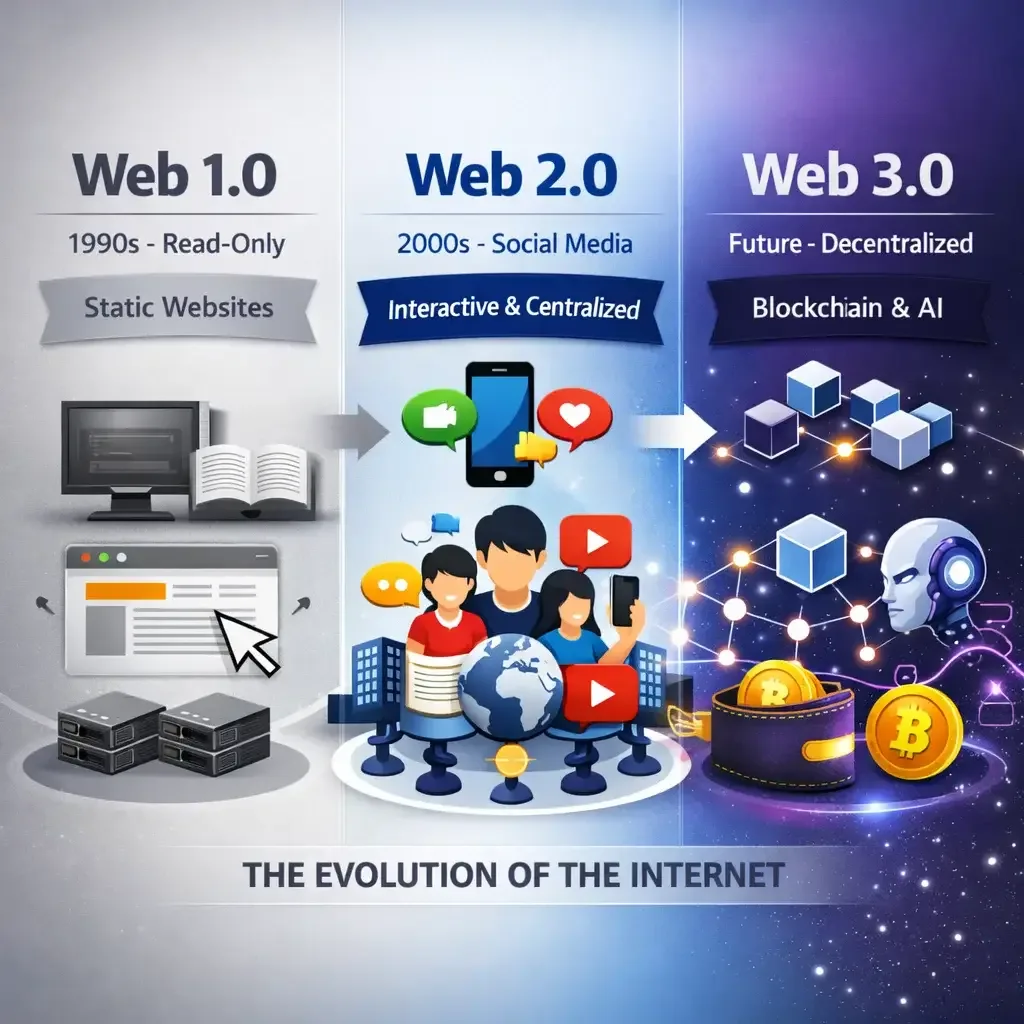
Evolution of the Web (From Read to Own)
The internet didn’t become powerful overnight — it evolved step by step, just like a story unfolding over time.
To understand Web 3.0, you first need to see where it all began.
Web 1.0 (1990s – Early 2000s) — The Read-Only Era
In the beginning, the internet was quiet and one-sided.
- Websites were static (no interaction)
- You could only read information
- No comments, no sharing, no accounts
Real example: Early websites like Yahoo mostly showed directories and information — you could visit a page, read content, and leave. No login, no sharing.
Think of Web 1.0 as a library where you can only read books, not write or interact.
Web 2.0 (2004 – Present) — The Social & Interactive Era
Then came a major shift — the internet became social.
- Users started creating content
- Platforms allowed sharing, commenting, and interaction
- Social media platforms like Facebook, YouTube, and Instagram changed everything
Real examples: Platforms likeFacebook, YouTube, and Instagram turned users into creators.
Now you could write, share, and connect — not just read.
⚠️ But there was a hidden truth:
Most of the data (posts, videos, behavior) was controlled and stored by big companies like Google and Meta.
Web 3.0 (2020s – Future) — The Ownership Era
Now, the internet is evolving again — towards Web 3.0.
- Users own their data and digital assets
- No central authority controls everything
- Blockchain ensures transparency and security
- Built on blockchain and smart technologies
Real example: Cryptocurrencies like Bitcoin allow people to transfer value without banks.
It’s no longer just about using the internet…
It’s about owning your place in it.
The Importance of Web 3.0
Web 3.0 is not just a trend; it’s a paradigm shift in digital interactions. It matters because:
- User Data Ownership – Individuals, not corporations, control personal data.
- Enhanced Privacy – Encryption and blockchain ensure data security.
- Financial Freedom – Cryptocurrency allows borderless transactions.
- Open Internet – Developers build applications without permission from tech giants.
Examples of Web 3.0 in Action
- Decentralized Finance (DeFi): Platforms like Uniswap and Aave enable lending, borrowing, and trading without banks.
- NFTs (Non-Fungible Tokens): Digital art, music, and collectibles stored securely on the blockchain.
- Decentralized Social Media: Networks like Lens Protocol and Mastodon give users content ownership.
- Metaverse: Virtual worlds built on blockchain where users buy land, assets, and interact in 3D environments.
Benefits of Web 3.0
- Greater transparency and trust.
- Fewer intermediaries, reducing costs.
- Enhanced security against hacking and misuse.
- Global accessibility, enabling equal opportunities for all.
Challenges of Web 3.0
- Scalability – Current blockchain networks face speed limitations.
- Adoption Barriers – Users need awareness and technical knowledge.
- Regulatory Uncertainty – Governments are still shaping policies around blockchain and crypto.
The Future of Web 3.0
As Web 3.0 technologies mature, we can expect:
- Smarter voice search and AI-powered search engines.
- Increased adoption of cryptocurrencies and digital wallets.
- Mainstream companies shifting toward decentralized platforms.
- A fully immersive digital economy combining blockchain, metaverse, and AI.
Conclusion
Web 3.0 represents the next evolution of the internet—a decentralized, secure, and user-centric ecosystem. While challenges remain, its potential to transform data ownership, online interactions, and global commerce is enormous. Businesses, developers, and individuals who adopt Web 3.0 early will have a strong advantage in the future digital world.





I am really thankful to the owner of this web page
who has shared this wonderful piece of writing at here.